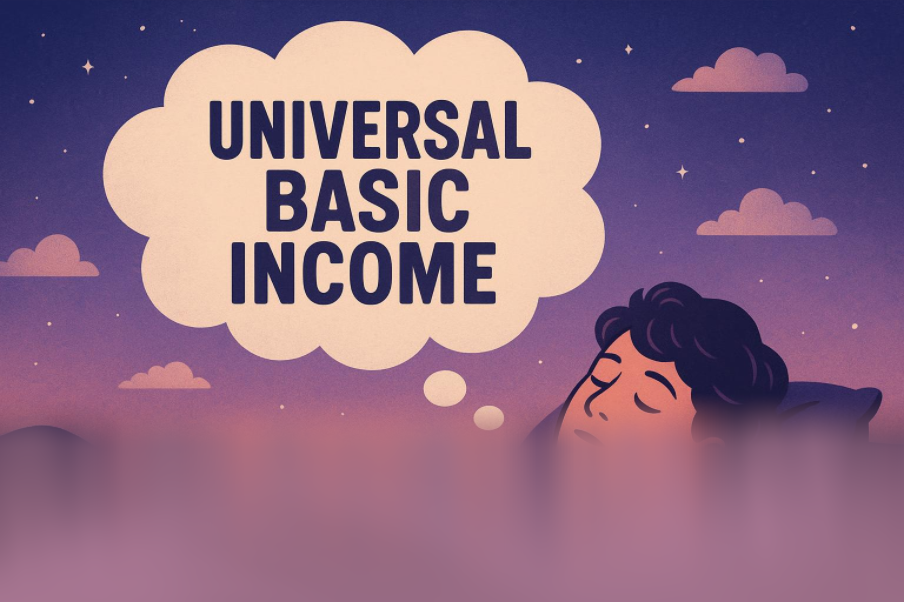
My Thoughts on Universal Basic Income
The Allure and the Abyss: Why Universal Basic Income Is Not the Easy Fix It Seems – My Analysis and Future Foresighting
In an era of accelerating automation, widening inequality, and existential questions about the future of work, Universal Basic Income (UBI) has emerged as one of the most seductive policy ideas of our time. The notion is simple: every adult citizen receives a regular, unconditional cash payment from the government, no strings attached. It promises to eradicate poverty, unleash human potential, and cushion the blows of technological upheaval. But as someone who has spent years analyzing economic trends, technological shifts, and societal transformations, I see UBI not as a straightforward solution but as a profoundly complex proposition.
This post is my personal analysis and future foresighting—a forward-looking examination grounded in historical context, empirical evidence from pilots worldwide, and my own projections about where technology, economics, and human behavior are headed. I’ll begin with the origins of the idea, its undeniable appeal, and why it feels urgent today. Then, I’ll lay out why UBI is far from an easy reality. It faces massive implementation hurdles, social acceptance barriers, funding shortfalls, deep philosophical questions about the value of life and work—and seven additional structural problems that make national-scale adoption extraordinarily difficult. The future I foresee is one where we must confront these realities head-on rather than chasing a utopian shortcut.
The Origins: How UBI Was Coined and Evolved
The concept of providing a guaranteed income to all is far older than the term “Universal Basic Income.” Early seeds appear in Thomas More’s Utopia (1516), where every citizen receives a basic subsistence. In the 1790s, Thomas Paine proposed a “ground rent” payment funded by land taxes to compensate people for the loss of common land rights. Similar ideas surfaced with Thomas Spence and later utopian socialists.
The modern terminology took shape in the 20th century. British economist G.D.H. Cole is widely credited with coining the phrase “basic income” in the 1930s (some sources pinpoint 1935), framing it as a social dividend within a planned economy. The fuller term “Universal Basic Income” gained global traction in the late 1980s through the work of philosopher Philippe Van Parijs and the founding of the Basic Income Earth Network (BIEN) in 1986. Economists like Milton Friedman popularized related ideas through the “negative income tax,” while figures such as Martin Luther King Jr. and even Richard Nixon explored guaranteed income proposals in the 1960s–70s.
What began as a philosophical and moral argument for dignity and equality has evolved into a pragmatic response to 21st-century challenges. Today, UBI is discussed not just as welfare reform but as a necessary adaptation to artificial intelligence, robotics, and the gig economy.
The Promise: What’s Good About UBI and Why It Matters
There is real merit to UBI that makes it worth serious consideration. In my analysis, its strongest advantages are:
-
Poverty reduction and inequality mitigation: Unconditional cash transfers have repeatedly shown strong results in pilots (from Kenya to Finland to U.S. cities like Stockton). They lift households above the poverty line, improve food security, housing stability, and child outcomes without the administrative overhead of means-tested programs.
-
Health and well-being gains: Multiple studies link UBI-style payments to better mental and physical health, reduced stress, and higher life satisfaction. Recipients report greater confidence, trust in institutions, and freedom to pursue education or caregiving.
-
Entrepreneurship and innovation boost: By removing the fear of destitution, UBI encourages risk-taking. Some pilots saw sharp rises in self-employment and small business starts—up to 300% in certain developing-world experiments.
-
Simplification of welfare systems: It replaces complex bureaucracies with a single, efficient payment, cutting administrative costs and eliminating poverty traps created by benefit cliffs.
-
Preparation for technological disruption: As AI and automation accelerate (potentially displacing hundreds of millions of jobs by 2030), UBI offers a floor that allows people to retrain, transition careers, or contribute in non-traditional ways—care work, creativity, community service—that markets often undervalue.
Why does this matter? In my future foresighting, we are entering an economy where productivity soars while traditional wage labor shrinks. Without a mechanism to share the gains of AI-driven abundance, inequality could explode, social cohesion could fracture, and political instability would follow. UBI represents one of the few ideas that treats people as citizens with inherent rights rather than mere labor inputs. It aligns with human dignity in a post-scarcity horizon. That is why it feels important—and why experiments continue around the globe.
The Harsh Realities: Proving UBI Is Not an Easy Reality
Yet here is where my analysis turns sober. For all its theoretical elegance, UBI is not a plug-and-play policy. Scaling it from small pilots (often funded privately or temporarily) to a permanent national program reveals profound frictions. In my foresighting—looking 10–20 years ahead at fiscal pressures, demographic shifts, AI productivity curves, and human psychology—I conclude that UBI is not an easy reality. It confronts four core challenges the user highlighted, plus seven more structural problems that compound the difficulty.
The Four Core Challenges
-
Implementation challenges: Designing, administering, and verifying a truly universal system at scale is a logistical nightmare. Who qualifies—citizens only, long-term residents, or everyone? How do you prevent fraud, handle international mobility, or integrate it with existing tax codes and benefits without creating massive new bureaucracies? Digital identity systems, real-time payment infrastructure, and data privacy safeguards would be required at unprecedented levels. Pilots work because they are small and short-term; a nationwide rollout would face years of technical and legal gridlock.
-
Social acceptance: Not everyone views “free money” as fair. Taxpayers who work hard may resent funding payments to those who choose not to work, fueling cultural backlash and political polarization. Stigma around “handouts” persists even when payments are universal. Public opinion surveys and past referendums (e.g., Switzerland’s 2016 vote) show deep divisions—support evaporates when costs become clear.
-
Enough funds: The numbers are staggering. A modest $1,000/month per adult in a large economy like the U.S. would cost trillions annually—roughly double current federal tax revenue. Funding via higher income taxes, VAT, wealth taxes, or carbon dividends sounds plausible on paper but triggers fierce resistance. Even “revenue-neutral” models that eliminate other welfare programs still require massive net new spending. In my foresighting, aging populations and slowing growth will make this fiscal burden even heavier.
-
Values of life question: At its core, UBI challenges deeply held beliefs about work, purpose, and human dignity. Does unconditional income erode the ethic of contribution and self-reliance? Does it devalue the intrinsic rewards of labor? Philosophers and critics argue that work provides structure, community, and meaning beyond income. If large numbers opt out of the workforce, society risks losing not just GDP but social fabric. Evidence from some experiments shows small drops in labor participation; scaled nationally, the cultural impact could be profound.
And Seven More Problems
These are not peripheral—they are systemic barriers I foresee amplifying the above issues:
-
Inflationary pressures: Injecting trillions into the economy without corresponding productivity gains in essentials (housing, food, healthcare) could drive up prices. Landlords and service providers might capture much of the new spending, leaving recipients no better off while eroding purchasing power for everyone else.
-
Labor market distortions: While some pilots show minimal employment drops, long-term national rollout could create shortages in low-wage or undesirable jobs. Employers might struggle to fill roles, wages in certain sectors could stagnate or rise unevenly, and overall economic dynamism might suffer if too many people reduce hours or exit entirely.
-
Political volatility and sustainability: Governments change. A UBI launched under one administration could be cut, clawed back, or turned conditional by the next. Without ironclad legal or constitutional protections, it becomes a political football—especially during recessions when budgets tighten.
-
Migration and border strains: A generous UBI would act as a magnet for immigration, potentially overwhelming systems in high-welfare nations. Controlling eligibility without undermining universality creates yet another administrative headache and political tension.
-
Opportunity cost and inefficiency: The enormous sums required for UBI could instead fund targeted interventions—education, job training, healthcare, or infrastructure—that address root causes of poverty more efficiently. Universal payments inevitably go to many who don’t need them, diluting impact.
-
Scalability and general equilibrium effects: Pilots are conducted in isolation with small samples and short durations. A full rollout changes incentives across the entire economy—tax behavior, investment decisions, family structures, even fertility rates. Macroeconomic models show mixed or negative long-term effects on growth when labor supply shrinks.
-
Cultural and regional mismatches: One-size-fits-all UBI ignores vast differences in cost of living, social norms, and economic structures across regions or countries. What works in a high-trust Nordic nation may falter in diverse, high-inequality contexts where trust in government is low.
In my future foresighting, these eleven interlocking problems do not mean UBI is impossible—they mean it is not easy. Technological abundance from AI might eventually make funding more feasible, but human psychology, political reality, and economic feedback loops will remain stubborn. Without addressing them through hybrid designs (e.g., partial UBI + strong safety nets + investment in human capital), we risk creating more problems than we solve.
A Balanced Forward Look
UBI is a powerful idea with noble roots and genuine upsides. It speaks to our desire for security and freedom in an uncertain future. Yet my analysis and foresighting lead me to the same conclusion: it is not an easy reality. The path forward demands rigorous debate, better-designed experiments, and perhaps incremental or conditional variants rather than a leap into full universality.
We owe it to future generations to pursue bold ideas—but with eyes wide open to the abyss beneath the allure. Only then can we build economic systems that truly honor human potential. ubi Note: This post reflects my independent analysis based on decades of economic history, pilot data, and technological trend forecasting. No single source or ideology shapes it.